Day 1
Tuesday, June 23, 2026
Cape Town, South Africa
| Late p.m. | Land at Cape Town. Taxi to Sea Point. |
|---|---|
| ~7:00 | Sweet Orange Guest House. Already dark. |
| Then | Walk out into the rain. Dinner forty meters away. |
We landed in the late afternoon and took a taxi out to the Sweet Orange Guest House — 1 Bellevue Road, Sea Point — a pink house behind a white iron gate, with the number on the pillar and an orange painted on the sign. It was around seven by the time we were standing in front of it, and already going dark.
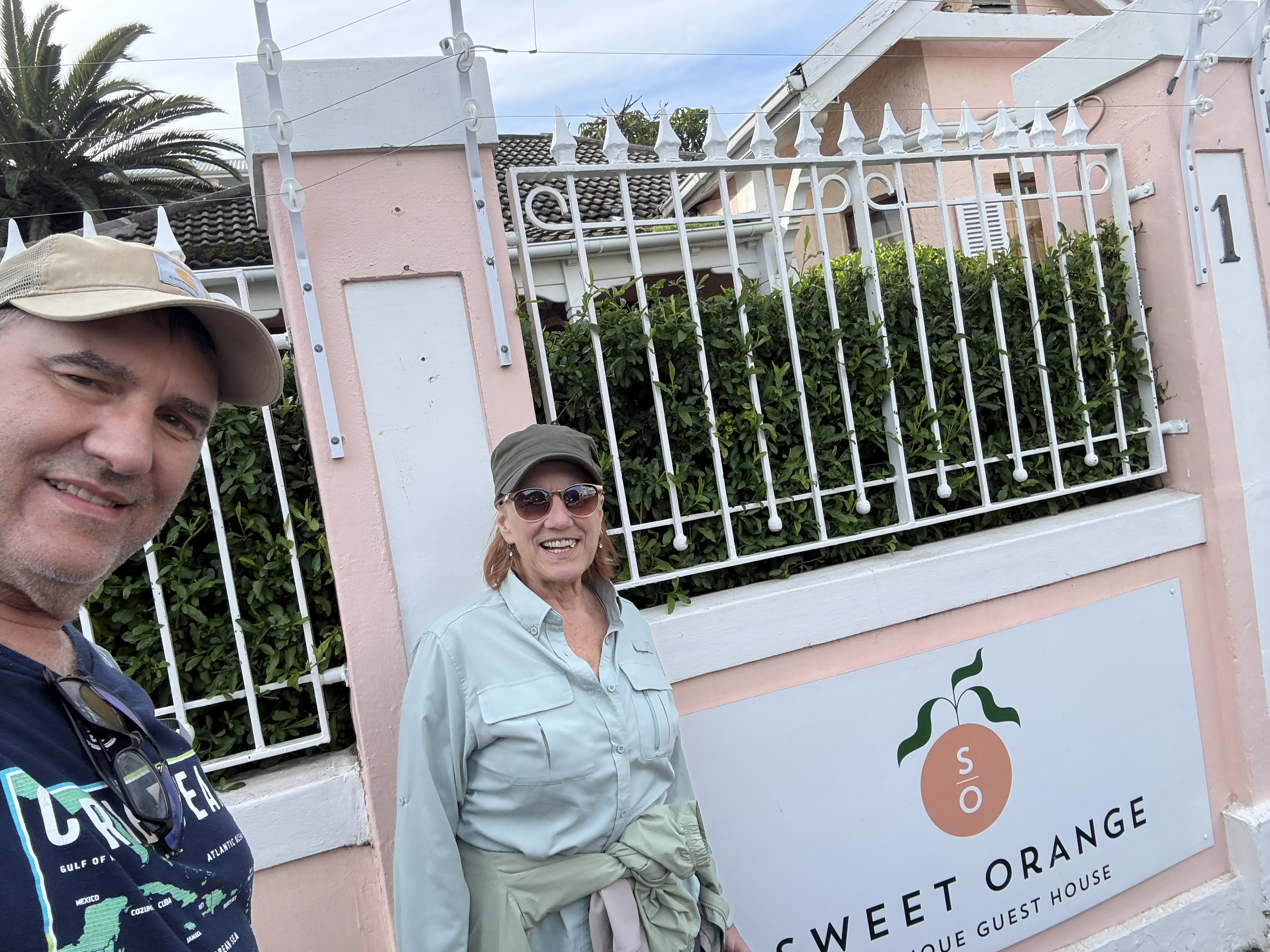
It was raining — a fine, dreary mist. We had crossed the planet and arrived in the dark, in the wet, in the winter. The woman who checked us in promised the weather would be better tomorrow. She turned out to be right, but you do not know that yet on the first evening, and standing in that doorway it sounded like the kind of thing people say. We had been traveling the better part of a day and a half. The sensible move was to sleep. Instead we dropped the bags and walked out into it. Forty meters up the road — close enough to see from the gate, right there where Bellevue meets Main — there was a Greek taverna with an evil eye painted on the ceiling and a blue-domed church on the wall. Mykonos. We sat down, wet and travel-stunned, and ordered as though we had any idea what we wanted. Bonnie asked what the white wine was and took the one they recommended. I had a Savanna Light — a hard cider, and what South Africa hands you instead of a beer. What we ate, I could not tell you. I have a photograph of the drinks and no memory whatsoever of the food, which tells you exactly how much of me was still in the air over the Atlantic.
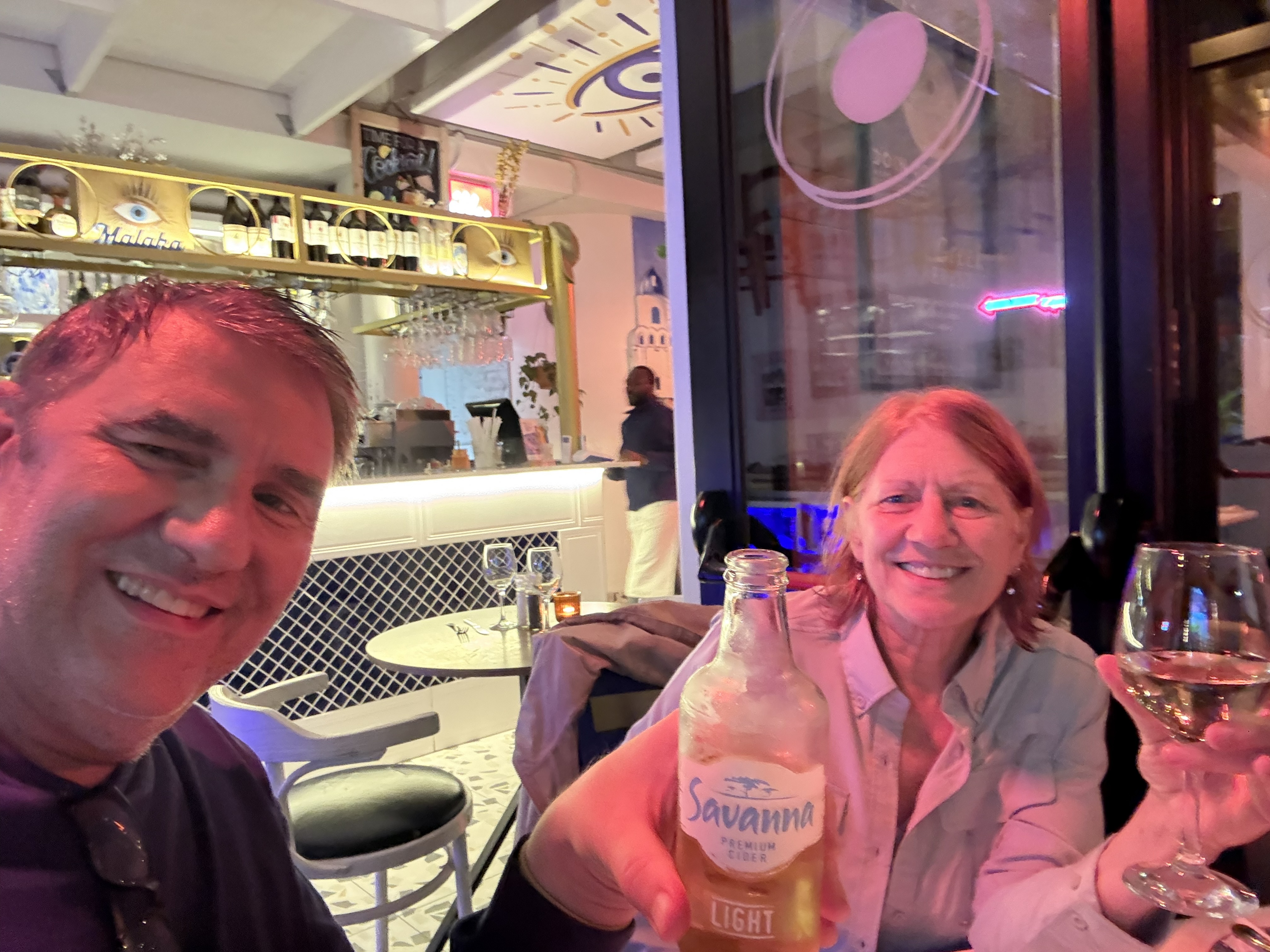
That was the moment, I think. Not the lion — the lion comes much later — but two jetlagged people in damp jackets in a Greek restaurant on the wrong side of the planet, ordering a salad and a pizza and raising a glass because we had actually gone and done it.
The Room
Sweet Orange was old-fashioned in the good way. There was no front desk — no desk at all, no lobby, nobody hovering — and they handed us actual metal keys, the kind you can lose. The room was clean and the bed was fine and nothing about either was fancy, which after thirty-odd hours of airplanes is not a complaint. It was a house, and we were staying in it. The wall had two kinds of socket in it: the enormous round-pinned South African one, and a European one beside it. Bonnie had brought a single universal converter and got lucky — it fitted. That was the whole of her electrical plan, and it happened to work. I had brought a system. I travel with a whole array of adapters, because you never quite know what a country, or one particular old socket, is going to hand you — but in any given room, only one of them turns out to fit. That is the real constraint, and it is not the wall. The room could have three hundred sockets in it and they would do me no good at all, because they are all the wrong shape and I own exactly one thing that fits them. Which is what the extension cord is for. This is a thing I have learned the hard way over a lot of trips and I will die on this hill: you do not need an adapter for every device. Put the one adapter that works into the wall, plug the cord into that, and now you have a row of your own familiar sockets — all of them, at once, from anywhere in the room. Without the cord I would have to carry three or four copies of whichever adapter turned out to be the right one, and I have no way of knowing in advance which one that will be. With it, one of each type is plenty. I had an iPhone, an Apple Watch, and a stack of battery packs to keep alive, and I never once had to choose which of them got the socket.
Money
We had also solved the money problem in opposite directions. Bonnie arrived with a serious quantity of rand, acquired in advance, the way you are told to. I arrived with none at all — dollars in my pocket and a credit card, and a plan to work it out as I went. I worked it out as I went. The card was accepted everywhere — restaurants, lodges, shops, airports — and where a card would not do, which was mostly tips, everybody took dollars, cheerfully and without comment. Not once, in three weeks and three countries, did anybody look at a twenty-dollar bill and shake their head. So the rand I never bought was money I never needed. I am reporting this, not recommending it. But it is what happened.